The Brutal Truth About Real Estate Marketing: Why Glossy Brochures Are Killing Your Sales
Let’s be honest about the state of the Dhaka property market. For years, the playbook hasn’t changed. You hire a firm to make a few shiny 3D renders, print five hundred gold-embossed brochures, and then wait for the phone to ring. But have you noticed how quiet that phone is lately? Recent data from the 2024 REHAB Annual Report shows that while interest in homeownership is at an all-time high, over 80% of digital leads are now classified as “low intent” or “junk.” This suggests a massive disconnect between how we sell and how people actually buy. The reality is that real estate marketing has evolved from a transaction of bricks and mortar into a competition for trust and lifestyle aspiration. If you’re still leaning on paper flyers to sell a 5-crore-taka apartment, you aren’t just behind the curve; you’re losing the room.
The Death of the Static Sales Pitch in Dhaka
I remember a time when a well-placed billboard on Airport Road was enough to sell out a project in Uttara. That world is gone. Today’s buyer in Dhaka is younger, tech-savvy, and deeply skeptical. They’ve seen the “luxury” tag used on everything from studio flats to palatial penthouses. Global trends tracked by McKinsey suggest that by 2026, 70% of the real estate journey will happen before a buyer even talks to a human agent.
In our local context, the problem is a “visualization gap.” According to the 2025 Bangladesh PropTech Review, only 15% of active projects offer any form of interactive digital experience. Most developers are still showing static images of “living rooms” that look like they were pulled from a generic IKEA catalog. When everyone uses the same visual language, your brand becomes invisible. What the data reveals is a shift where the neighborhood’s story the coffee shop around the corner, the security protocols, the air quality matters as much as the floor plan.
The Science of Selling a Future You Can’t Touch
This is where it gets interesting. Real estate is one of the few industries where we ask people to pay millions for something that doesn’t exist yet. That requires a psychological bridge. In my analysis, the most successful brands in Dhaka right now aren’t selling “3BHK at 2500 sq ft.” They are selling “The Tuesday Morning Routine.”
Think about the mental load of a CXO living in Banani. They don’t want to hear about the grade of the rods used in the foundation, they assume that’s handled. They want to know if the parking garage has EV charging or if the rooftop garden actually has enough shade for a 7:00 AM yoga session. Research into consumer behavior shows that immersive experiences, like 1:1 scale VR tours, increase “emotional ownership” by 40% compared to looking at a brochure.
Why Real Estate Marketing Must Be Immersive
To move beyond the paper-thin promises of the past, we have to look at the “Immersive Value Chain.” It’s not just about flashy tech; it’s about reducing the friction of the unknown. When a buyer can “walk” through their future kitchen on their iPad while sitting in a traffic jam on Elevating Expressway, you’ve captured their most valuable asset: their time.
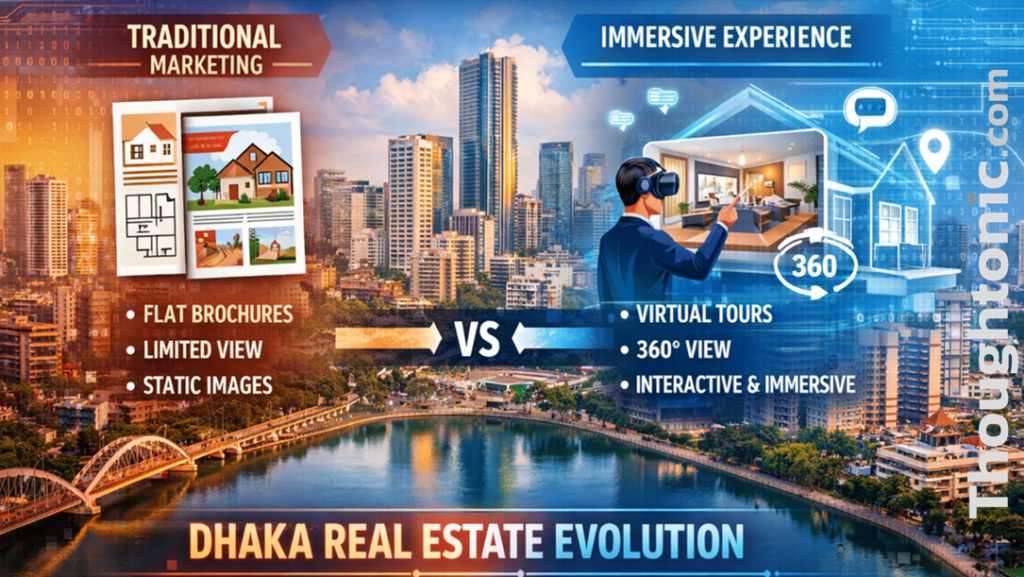
| Feature | The Old Way (Brochure) | The New Way (Immersive) |
| Visuals | Static Renders | 360° Walkthroughs |
| Narrative | Feature-heavy (Lift, Generator) | Benefit-heavy (Zero-downtime life) |
| Trust | “Trust us” slogans | Real-time construction tracking |
| Reach | Physical distribution | Targeted, persona-based digital ads |
A 4-Step Framework for Modern Real Estate Marketing
If you want to move your brand into 2026, you need a system that treats marketing as an experience, not a department. Here is how I suggest you structure it.
-
Kill the “Luxury” Buzzword
The word is overused and meaningless. Instead, define your specific niche. Are you the “Wellness Developer” or the “Tech-Integrated Hub”?
- The Mistake: Trying to be everything to everyone.
- The Action: Choose one pillar—like sustainability or community—and make it your entire visual identity.
-
Audit Your Digital Trust Score
Before a buyer visits your site, they’ve already Googled your directors and checked your Facebook comments.
- The Mistake: Ignoring negative reviews or having an “Under Construction” website.
- The Action: Publish your handover history and current project statuses transparently.
-
Move to Neighborhood Storytelling
Stop marketing the plot; start marketing the 1-kilometer radius.
- The Mistake: Only showing the building in a void.
- The Action: Create video content featuring local school principals, gym owners, and the best “moshla cha” stalls nearby.
-
Deploy VR for High-Intent Leads
Stop wasting time giving physical tours to people who aren’t ready.
- The Mistake: Thinking VR is just a gimmick for exhibitions.
- The Action: Use VR as a “gate” to qualify leads. If they spend 10 minutes in a virtual tour, they are worth a phone call.
Learning from the Best: Case Studies
Let’s look at who is doing this right. Globally, look at The Line in Saudi Arabia. They aren’t selling apartments; they are selling a radical new way for humans to live. By the time the first stone was laid, they had already built a global brand.
Closer to home, Shanta Holdings in Bangladesh remains the gold standard. Why? Because they understood early on that real estate marketing is actually about hospitality. They don’t just hand over keys; they manage the lifestyle after the sale. Their marketing reflects this by focusing on the “lived experience” rather than the construction process. The limitation here is scale. It’s hard to maintain that level of “high-touch” service as you grow, but it’s exactly why they can command a 25% price premium over competitors.
The Action Plan for Founders and CXOs
If you are leading a real estate firm, your first step is a budget audit.
- For Organizations: Shift 30% of your traditional print budget into high-end video production and 3D environment building. This isn’t a “nice to have” anymore. It’s the cost of entry. Expect a 6-month lag before you see the lead quality shift, but the “cost per acquisition” will drop once your brand narrative takes hold.
- For Professionals: Start learning the basics of psychological pricing and spatial storytelling. The most valuable person in the room is no longer the guy who can close a sale with a “discount,” but the one who can articulate why this specific square footage makes the buyer’s life 10% easier.
The Contrarian View: Is More Tech Always Better?
But here’s the thing: tech can’t fix a bad product. The reality is more nuanced. You can have the most beautiful VR tour in the world, but if the apartment has poor natural light or bad ventilation, the “immersion” will only highlight the flaws. There is also a real risk of “digital fatigue.” Sometimes, a handwritten note or a small, private dinner for ten potential buyers in a finished project will outperform a 1-crore-taka digital campaign. Use the tech to open the door, but use human connection to close it.
Key Takeaways
- The “glossy brochure” is now a liability; it signals an outdated company.
- Real estate marketing must focus on the “Neighborhood Story” to build genuine desire.
- Over 80% of digital leads are currently junk because of generic messaging.
- VR tours increase emotional ownership by roughly 40%.
- Brands like Shanta Holdings prove that lifestyle branding justifies a 20-30% price premium.
- Founders should shift 30% of print budgets to immersive digital assets immediately.
- Trust is the primary currency in 2026, driven by transparency and data.
Read More Articles:
Quantum Marketing: How 2030’s Technologies Will Shatter Bangladesh’s Status QuoDigital Literacy & Brand Purpose: How Education Drives Loyalty in Emerging MarketsGenerative AI in Bangladeshi Advertising: Opportunities, Ethical Risks & Implementation Guide 2025The Brain’s Buy Button: How Neuromarketing Taps into Consumer Decision-Making (Global & Bangladesh Insights)Beyond the Bot: The Empathy Mandate for AI-Driven Customer Service in Bangladesh: A Data-Driven Roadmap
Bibliography
- REHAB – Annual Real Estate Report 2024
- LightCastle Partners – Bangladesh Consumer Insights 2024
- McKinsey & Co – The Future of Real Estate 2030
- Bangladesh PropTech Review – Digital Transformation 2025
- Deloitte – Global Real Estate Outlook 2025
- Knight Frank – The Wealth Report 2025
- Bproperty – Dhaka Market Analysis Q4 2024
- Daily Star Business – Real Estate Trends in Bangladesh
- Financial Express – Urban Development Challenges 2026
- Zillow – PropTech Trends and AI Integration
- Meta – South Asia Digital Marketing Benchmarks 2025
- Harvard Business Review – The Psychology of Luxury Sales
- National Association of Realtors (NAR) – 2025 Technology Survey
- Forbes – Why Storytelling Sells High-End Property
- World Bank – Bangladesh Urbanization Data 2024