Why Branded Podcasts in Bangladesh Are a Proven Strategy for 2026
Look around you the next time you’re stuck at the Mohakhali flyover or crawling through Kawran Bazar. The windows are rolled up, the AC is humming, and almost every passenger in every car or ride-share is wearing headphones. We’re a city in a permanent state of transit, yet we’ve reached a point where we can no longer look at our screens. The bumps on the road make reading impossible, and watching a video for an hour while stuck in a rickshaw is a recipe for a headache.
But here’s the thing: while the eyes are occupied with the chaos of the street, the ears are wide open. In my analysis, branded podcasts in Bangladesh have moved from being a “nice-to-have” experimental project to a critical survival tool for brands that want to own the “dead hour” of the Dhaka commute. We are currently witnessing an audio renaissance where attention is the new currency, and the most valuable real estate isn’t a billboard on Airport Road; it’s the space between your customer’s noise-canceling headphones.
The Brutal Reality of the Dhaka Attention Economy
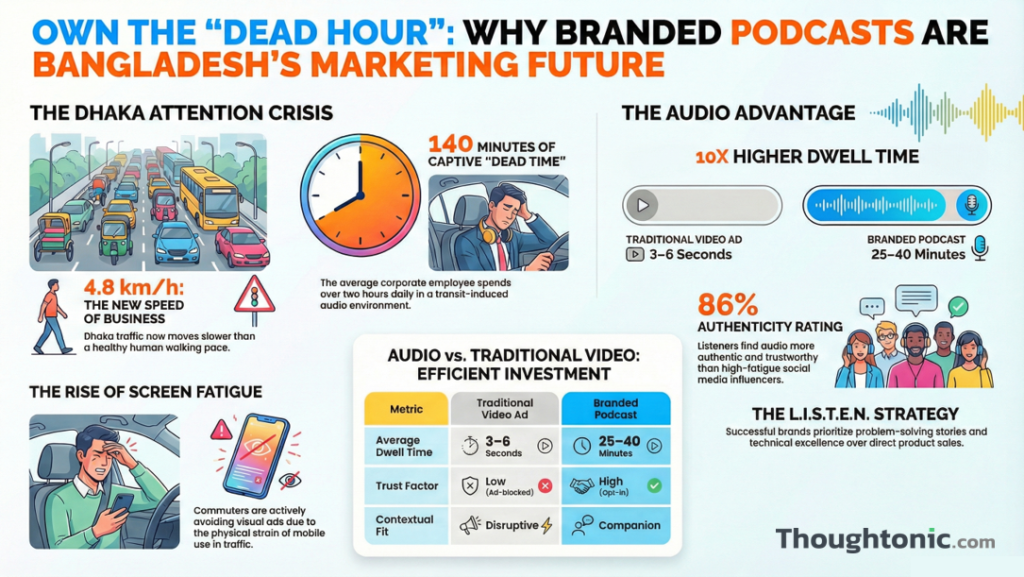
The numbers don’t lie, and for a marketing head, they’re quite sobering. Dhaka’s average traffic speed has officially dipped to 4.8 km/h. To put that in perspective, a healthy human walks faster than a bus moves in Gulshan. Data from the end of 2025 shows that the average one-way commute for a corporate employee is now roughly 70 minutes. That is 140 minutes a day of a “captive audience” that is currently being ignored by local brands.
While digital ad spend in the country is projected to hit $3.8 billion this year, most of that money is being poured into visual formats that people are actively trying to avoid. We’re seeing a massive rise in “screen fatigue.” With 5G now finally stabilized across the metro areas, people aren’t just scrolling through Facebook; they’re escaping into audio. The reality is more nuanced than just “people like music.” What we’re seeing in the 2026 data is a shift toward “utilitarian listening.” People want to feel like their time in traffic isn’t wasted.
Why Audio Wins When Video Fails
It’s a question of cognitive load. Watching a high-production video requires 100 percent of your visual and auditory focus. In a moving vehicle in Dhaka, that’s physically draining. Audio, however, is a companion medium. It allows the listener to “multitask” their boredom. This is where it gets interesting: global stats show that 86 percent of podcast listeners find the medium more authentic than traditional social media. In a market like ours, where influencer fatigue is at an all-time high, the intimacy of a voice in your ear for 30 minutes creates a level of trust that a 15-second Reel simply cannot touch.
The Science Behind “Share of Ear”
This isn’t just about entertainment; it’s about how our brains process information during “low-stakes” activities like sitting in a car. Research shows that audio content triggers a higher degree of mental imagery than visual content. When you listen to a well-told story, your brain actually works harder to “see” the brand’s world. For a senior marketer, this means your brand isn’t just a logo on a screen; it becomes a voice, a personality, and eventually, a trusted advisor.
The L.I.S.T.E.N. Framework for 2026
If you’re looking to build a successful branded podcasts in Bangladesh strategy, you can’t just record a Zoom call and call it a day. You need a structured approach:
- Locate the Gap: What is the one thing your customers are confused about? Don’t sell your product; solve their problem.
- Identify the Voice: Skip the corporate “announcer” voice. You need someone who sounds like a clever friend.
- Story over Sales: Use a narrative arc. If you’re a bank, don’t talk about interest rates; tell the story of a founder who almost lost everything.
- Technical Excellence: In 2026, listeners have no patience for bad audio. If it sounds like it was recorded in a bathroom, they will switch to Spotify in three seconds.
- Echo the Content: One 40-minute episode should provide you with 10 LinkedIn posts, 5 short clips, and 2 newsletter deep dives.
| Metric | Traditional Video Ad | Branded Podcast |
| Average Dwell Time | 3–6 Seconds | 25–40 Minutes |
| Trust Factor | Low (Ad-blocked) | High (Opt-in) |
| Production Cost | Very High | Moderate |
| Contextual Fit | Disruptive | Companion |
Case Studies: From Global Giants to Local Pioneers
Let’s look at who is doing this right. Globally, the “ZOE Science & Nutrition” podcast has become a masterclass in this. They didn’t start by selling supplements. They started by explaining how the gut works. By the time they mention their product, the listener already views them as a scientific authority. They’ve managed to turn their marketing budget into a media house that people actually subscribe to.
Closer to home, we’re seeing a shift in how South Asian tech leaders use audio. While we don’t have a “standard” branded podcast that everyone points to yet, the rise of long-form interview shows in the region proves the appetite is there. In my analysis, a local logistics or fintech giant could easily own the “SME education” space by launching a series that helps small business owners navigate the complexities of the 2026 economy. The mistake most make is being too “brand-heavy.” The successful ones are the ones that act like a curator of great conversations.
Your 2026 Action Plan: Orgs and Professionals
The transition to audio isn’t just a tactical change; it’s a structural one. If you’re a CXO, you need to stop asking “How many views did we get?” and start asking “How many minutes did they give us?”
For Organizations:
- Budget for Talent, Not Just Tech: Stop buying the most expensive cameras. Hire a professional scriptwriter who knows how to write for the ear.
- The 3-Episode Rule: Don’t even look at the data until you’ve released at least 10 episodes. Podcasts are a long-game play.
- Internal First: If your own employees won’t listen to it, your customers definitely won’t. Use a podcast for internal culture building first to test the waters.
For Professionals:
- Master the “Uncomfortable” Interview: Learn to ask the questions that actually matter, not just the ones that make the brand look good.
- Audio SEO: Learn how to optimize for voice search and podcast directories. It’s a completely different beast than Google SEO.
The Contrarian View: When You Should Stay Away
Let’s be honest: branded podcasts in Bangladesh aren’t for everyone. If your brand is purely transactional and you have nothing interesting to say about your industry, a podcast will only highlight your lack of depth. The biggest risk in 2026 isn’t failing to launch; it’s “podfading” starting a show with great fanfare and then letting it die after four episodes because the “leads” didn’t pour in immediately.
The reality is that audio is a high-trust, slow-burn medium. If you’re under pressure for quarterly sales targets, stick to performance marketing. But if you’re building a brand that wants to be relevant in 2030, you need to start talking now. Sometimes, doing less content but making it deeply immersive is the only way to cut through the noise of a city that never stops honking.
Key Takeaways for the C-Suite
- Dhaka commuters spend 100+ minutes daily in “captive” audio environments.
- Branded podcasts in Bangladesh offer a trust-based alternative to declining video engagement.
- 5G stability in 2026 makes high-quality audio streaming the default for commuters.
- Production costs for audio are significantly lower than high-end video, yet dwell time is 10x higher.
- Focus on “Utility” over “Promotion” to avoid the 90% podfade rate.
- The median mobile download speed in Bangladesh has hit 36.84 Mbps, making seamless audio a reality (Ookla, 2025).
- 81% of podcast fans find audio ads more noticeable than TV or social media ads (Meetanshi, 2025).
More Articles:
Quantum Marketing: How 2030’s Technologies Will Shatter Bangladesh’s Status QuoDigital Literacy & Brand Purpose: How Education Drives Loyalty in Emerging MarketsGenerative AI in Bangladeshi Advertising: Opportunities, Ethical Risks & Implementation Guide 2025The Brain’s Buy Button: How Neuromarketing Taps into Consumer Decision-Making (Global & Bangladesh Insights)Beyond the Bot: The Empathy Mandate for AI-Driven Customer Service in Bangladesh: A Data-Driven Roadmap
Bibliography
- Digital 2026: Bangladesh – DataReportal, October 2025
- Transport in Dhaka – Statistics and Trends – Wikipedia, January 2026
- Podcast Statistics: Global Listeners & Demographics – Meetanshi, January 2026
- Bangladesh Digital Ad Spend Market Size & Forecast – Research and Markets, Q1 2026
- Traffic Congestion and Its Economic Impact in Dhaka – ResearchGate, January 2026
- Global Podcasting Market Growth 2026 – PodcastVideos, January 2026
- Podcasting in 2026: Industry Predictions – Acast, January 2026
- Internet in Bangladesh Growth Status – Wikipedia, 2025
- As the nation builds, Dhaka crawls – The Business Standard, September 2025
- Podcast Statistics 2025: Global Listener Growth – Teleprompter, November 2025
- The 10 Best Branded Podcast Examples in 2025 – Native Advertising Institute, August 2025
- Podcasting Market Size and Trends Analysis – The Business Research Company, January 2026
- Global Ad Spend Outlook 2024/25 – WARC, 2025
- Traffic in Dhaka, Bangladesh – Cost of Living – Numbeo, July 2025
- Top digital marketing trends and predictions for 2026 – Google Think, December 2025