Customer Service as the New Marketing: The Brutal Truth About Chatbots
Customer Service as the New Marketing: The Chatbot vs. The “Bhaiya”
We are automating everything in Bangladesh right now. From banking apps to grocery delivery, we are obsessed with “scaling.” But here’s the thing. In our rush to cut costs, we’ve forgotten a fundamental truth about our market. Bangladesh runs on relationships. It runs on the “Bhaiya, ektu dekhen na” (Brother, please look into it) culture.
When you replace that reassurance with a rigid decision tree, you aren’t just saving money on support costs. You are actively burning your brand equity.
In my analysis, Customer Service as marketing isn’t just a catchy phrase. It is the single biggest missed opportunity for Bangladeshi brands in 2026.
The Core Problem: The Efficiency Trap
The numbers tell a confusing story. If you look at company reports, everything is “up.” Chatbot deflection rates are high, operational costs are low, and tickets are being “resolved.”
But look closer at the sentiment.
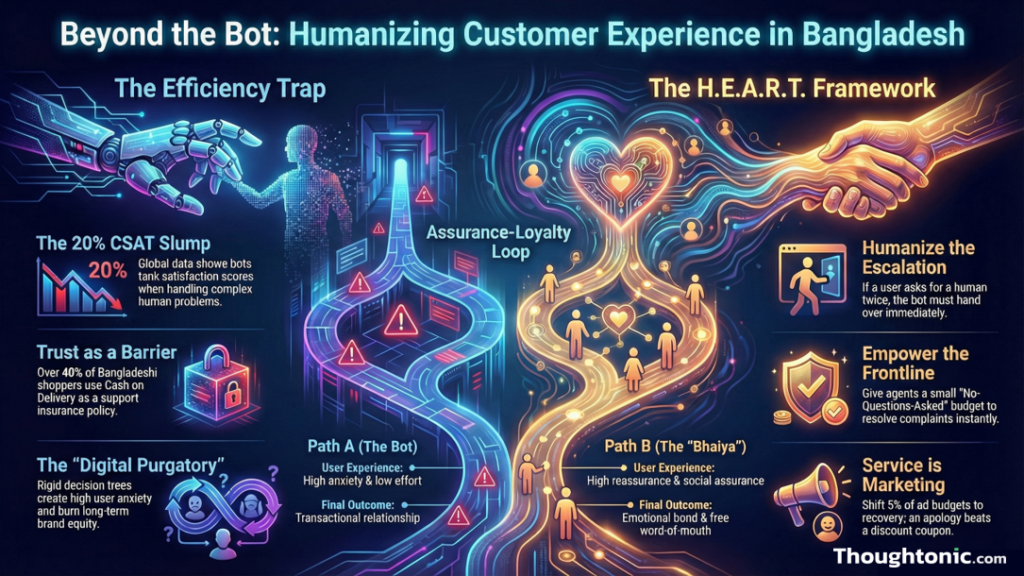
Global data from Gartner suggests that while bots handle volume well, they tank customer satisfaction (CSAT) scores by up to 20% when the issue is complex. In Bangladesh, this is amplified. A 2024 report by DATABD.co highlighted that trust remains the primary barrier to e-commerce adoption here. When a customer encounters a wall of silence or a generic auto-reply during a crisis, like a failed bKash transaction or a missing parcel, they don’t think, “Oh, their system is busy.” They think, “This company is a scam.”
Over 40% of our online shoppers still insist on Cash on Delivery. Why? It isn’t just a payment preference. It is a trust mechanism. It’s their insurance policy against a customer service department they know won’t help them if things go wrong.
We are treating support as a cost to be minimized. In reality, it is the most potent marketing channel we have left.
The Science: Why “Bhaiya” Beats the Bot
This isn’t just nostalgia for the old days. It is behavioral economics.
In a high-context culture like South Asia, communication is implicit. We value the “human touch” because it conveys accountability. When a “Bhaiya” (support agent) says, “Don’t worry, I’m checking it personally,” he is offering something an AI cannot: Social Assurance.
Getty Images
Harvard Business Review calls this the “Service-Profit Chain.” Employee satisfaction drives customer value, which drives loyalty. But I’d propose a modified version for Bangladesh called The Assurance-Loyalty Loop.
- Friction Event: Something goes wrong (product failure, delay).
- Resolution Attempt: Customer reaches out.
- The Fork:
- Path A (The Bot): Low effort for company, high anxiety for user. Result is a transactional relationship.
- Path B (The Bhaiya): High effort for company, high reassurance for user. Result is an emotional bond.
- Outcome: Path B generates a “story.” The customer tells their friends, “They actually called me back.”
That story? That’s your marketing. And it’s free.
A Practical Framework: H.E.A.R.T.
So, do we fire the bots? No. We just stop asking them to do a human’s job. We need to shift from “Deflection” to “Connection.”
Here is a 5-step framework to operationalize customer service as marketing:
- Humanize the Escalation
Stop hiding your phone number. The decision to bury contact details might save you manpower, but it costs you LTV (Lifetime Value).
- Action: If a user types “agent,” “human,” or “fake” twice, the bot should instantly hand over to a person. No arguments.
- The Mistake: Forcing users to select from a menu when they are clearly angry.
- Empower the Frontline
Your agents are your CMOs. If they have to say “let me ask my supervisor” for a 200 Taka refund, you’ve already lost.
- Action: Give every support agent a “No-Questions-Asked” budget (e.g., up to 500 BDT).
- Example: Ritz-Carlton allows employees $2,000 to fix guest issues. You can start with 500 Taka.
- Analyze the Friction
Most marketing teams look at ad clicks. Smart marketing teams look at support tickets.
- Action: Monthly meetings where the Head of Support shows the Head of Product the top 5 reasons customers are crying.
- The Reality: If 20% of your calls are about “confusing checkout,” that’s not a support problem. That’s a conversion problem.
- Re-invest in Talent
Stop outsourcing your voice to the lowest bidder.
- Action: Hire fewer agents, but pay them 30% above market rate. Call them “Customer Success Specialists,” not “Support Execs.”
- Trade-off: Higher salary bill vs. significantly higher retention.
Case Studies: The Tale of Two Cities
The Global Standard: Zappos Zappos didn’t sell shoes. They sold service. They famously once had a support call record of over 10 hours. They encouraged agents to talk about anything, not just shoes.
- The Result: 75% of their orders came from repeat customers. They spent minimal amounts on traditional advertising because their service was the marketing.
The Local Reality: Chaldal vs. The Rest In the early days of Chaldal (around 2015-2016), their “special sauce” wasn’t just the app. It was the recovery. If an egg broke, you didn’t just get a refund. You often got a human apology and a replacement within hours.
- The Contrast: Compare this to many ride-sharing apps today. If a driver cancels or misbehaves, you are often left fighting a bot for a generic refund coupon. The result? Zero loyalty. We switch apps based on a 10 Taka difference because we feel no connection to the brand.
Action Plans
For Organizations
- Budget: Shift 5% of your “Brand Awareness” ad budget into “Customer Recovery.” It yields better ROI.
- Timeline: Implement the “2-strike” rule for your chatbot this quarter.
- Metric: Stop measuring “Average Handling Time” (speed). Start measuring “Net Promoter Score” (joy).
For Professionals
- The Skill: Learn “De-escalation Improv.” Move away from scripts. Talk like a normal person.
- The Mindset: When a customer complains, don’t get defensive. Get curious. That complaint is data that your competitor is paying thousands of dollars to find out.
Critical Perspective: The Trap of “Over-Humanizing”
I need to add a caveat here. The reality is more nuanced. You cannot scale a “Bhaiya” to 10 million users without going bankrupt.
There is a risk of over-correction. If you force humans to handle simple queries like “what is my balance?”, you are wasting talent. The goal isn’t no automation. It’s smart automation. Use AI to fetch the data, but use humans to deliver the bad news or the complex solution.
Also, be careful of the “Uncanny Valley” of service, where a bot pretends to be human (using slang, emojis) but fails to understand basic context. That is more insulting than a dry, honest robot.
Key Takeaways
- Service is Marketing: Every ticket is a potential viral story (positive or negative).
- The “Bhaiya” Factor: In Bangladesh, trust is built on human assurance, not algorithmic perfection.
- Metric Shift: Move from “Deflection Rate” to “Retention Rate.”
- Empowerment: Trust your agents with small budgets to solve big mood swings.
- The Balance: Automate the predictable; humanize the exceptional.
- The Bottom Line: An empathetic apology is worth more than a 10% discount coupon.
Read More Articles:
Quantum Marketing: How 2030’s Technologies Will Shatter Bangladesh’s Status QuoDigital Literacy & Brand Purpose: How Education Drives Loyalty in Emerging MarketsGenerative AI in Bangladeshi Advertising: Opportunities, Ethical Risks & Implementation Guide 2025The Brain’s Buy Button: How Neuromarketing Taps into Consumer Decision-Making (Global & Bangladesh Insights)Beyond the Bot: The Empathy Mandate for AI-Driven Customer Service in Bangladesh: A Data-Driven Roadmap
Bibliography
- Gartner. (2024). Customer Service & Support Survey
- Qualtrics. (2024). Global Consumer Trends Report
- DATABD.co. (2024). State of E-commerce in Bangladesh
- Harvard Business Review. (2008). The Service-Profit Chain
- McKinsey & Company. (2023). The Value of Getting Personalization Right
- Sprout Social. (2024). The Sprout Social Index
- LightCastle Partners. (2024). Bangladesh Startup Ecosystem Assessment
- Zendesk. (2024). CX Trends Report
- Salesforce. (2023). State of the Connected Customer
- Bain & Company. (2023). The Economics of Loyalty
- Forbes. (2023). Why Customer Service is the New Marketing
- The Daily Star. (2024). Rising Complaints in E-commerce Sectors
- MIT Sloan Management Review. (2024). The Human-AI Interface in Service
- Accenture. (2023). Life Centricity: Playbook for Growth
- Dhaka Tribune. (2024). The Growth of F-Commerce in Bangladesh