The Hidden Dark Social of Dhaka: Why Your Analytics Miss the Real Story
Last week, a meme landed in my family WhatsApp group. It was a clever parody of a popular beverage brand’s latest TVC. By the time I saw it, the video had already been “forwarded many times.” But when I checked the brand’s official Facebook page? Crickets. A few hundred likes, three generic comments, and zero hint of the wildfire spreading through the private threads of Dhanmondi and Gulshan.
This is where the real influence happens. While we obsess over public engagement, the actual movement of brands in Bangladesh is being driven by a force we can’t see. In my analysis, dark social of Dhaka is the single most undervalued metric in our industry today.
But here’s the thing: if you’re relying on standard Google Analytics or Meta Business Suite to tell you why your sales are up, you’re likely getting half the story. The reality is that in a culture built on “Adda” and tight-knit circles, the most powerful marketing isn’t public. It’s hidden.
The Brutal Truth Behind the Dark Social of Dhaka
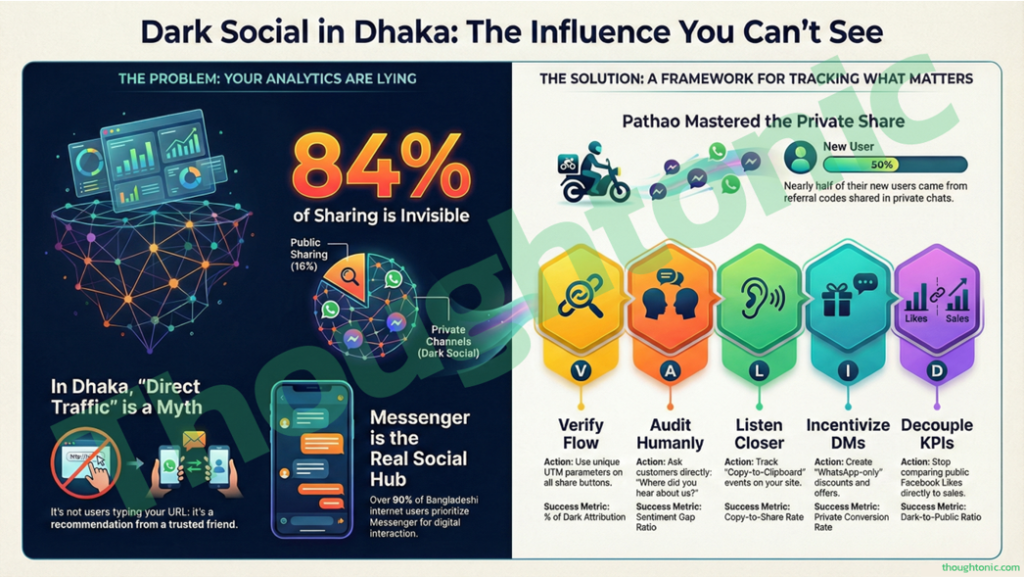
In the West, people might share a product to their “Timeline” to build a personal brand. In Bangladesh, we don’t do that. We’re private. We’re skeptical. We share via Messenger, WhatsApp, and imo. According to recent data heading into 2026, over 90% of internet users in Bangladesh prioritize Messenger as their primary mode of digital interaction.
When was the last time you clicked a public share button versus just DMing a link to a friend?
This creates a massive data gap. When a user copies a link from your site and pastes it into a private chat, most analytics tools categorize that as “Direct Traffic.” They assume the person typed your URL into their browser. In reality, it was a recommendation from a trusted cousin. This isn’t just a tracking error; it’s a strategic disaster. Industry data suggests that up to 84% of consumer sharing now happens via these invisible channels. In Dhaka, where the “Copy-Paste” culture is the default, that number is likely even higher.
Why Our Current Models Are Broken
This is where it gets interesting. Most senior marketers in Dhaka are still evaluated on “Cost Per Engagement” (CPE) or “Reach.” But those metrics only track the tip of the iceberg.
The Psychology of Private Sharing
A public comment on a brand’s post is a performance. A private message is a conversation. When a consumer DMs a link to a new skincare brand to her group of five friends, that recommendation carries 10x the weight of a sponsored influencer post. Yet, our current attribution models give 100% of the credit to the “Final Click,” usually a search or a direct visit, completely ignoring the dark social of Dhaka thread that started the journey.
The Problem with “Direct” Traffic
If you look at your 2026 dashboard and see a spike in “Direct” traffic, don’t celebrate yet. It’s a sign that your brand is being talked about, but it’s also a sign that you have no idea why. Without tracking the dark social of Dhaka, you’re essentially flying a plane with half the instruments blacked out.
The V.A.L.I.D. Framework: Mapping the Invisible
To win in this environment, you need to stop looking at what’s visible and start measuring what’s impactful. Here is a 5-step framework I’ve used to help brands navigate this.
| Step | Action | The Mistake | Success Metric |
| Verify Flow | Use UTM parameters for every single “Share” button. | Using generic URLs that don’t track the source. | % of Dark Attribution |
| Audit Humanly | Run monthly focus groups to ask: “Where did you really hear about us?” | Trusting digital dashboards over human words. | Sentiment Gap Ratio |
| Listen Closer | Tag “Copy-to-Clipboard” events in Google Tag Manager. | Assuming a “Copy” isn’t a “Share.” | Copy-to-Share Rate |
| Incentivize DMs | Create “WhatsApp-only” discounts or early access. | Only offering promos on public pages. | Private Conversion Rate |
| Decouple KPIs | Stop comparing FB Likes to Sales; they are different worlds. | Using public engagement as a proxy for intent. | Dark-to-Public Ratio |
Case Studies: The Power of the Private Thread
Global Insight: Adidas and the Tango Squads
Adidas realized that young footballers weren’t talking to the brand on public pages. They created “Tango Squads,” which were private messaging groups for influencers in major cities. They shared exclusive content there first. The result? They saw a 20% higher conversion rate through these dark channels than through their multi-million dollar public campaigns.
Local Context: Pathao’s Referral Engines
Pathao, the Bangladeshi tech giant, didn’t become a household name through just billboards. They mastered the art of the private share. Their “Referral Code” system was designed to be copy-pasted into Messenger groups. In recent reports, nearly half of their new user acquisition was driven by these “Direct” links. They didn’t care about the FB “Like”; they cared about the link being pasted into a group of five hungry friends.
Your 2026 Action Plan
For organizations, the shift is uncomfortable. It requires moving budget away from “pretty” public-facing campaigns toward technical infrastructure.
- Technical Audit (Month 1): Implement tracking for “Copy” events and WhatsApp share buttons. Total cost is low, but effort is high for dev teams.
- Asset Redesign (Month 2): Stop making square videos for FB feeds. Start making vertical, “forward-friendly” clips for WhatsApp.
- The “Human” Layer (Ongoing): Set aside 10% of your research budget for qualitative interviews. Stop asking what they bought; ask who sent them the link.
For professionals, the most uncomfortable skill you’ll need is learning to tell a CEO that the “Viral” post they love actually didn’t drive a single sale, while a “dead” post was actually shared 5,000 times in private.
A Critical Perspective: The Risk of Intrusion
There’s a danger here. As we get better at tracking the dark social of Dhaka, the temptation will be to “invade” these spaces. Don’t. There is nothing more annoying to a Bangladeshi consumer than a brand representative joining a private family WhatsApp group or spamming DMs.
The goal isn’t to be in the conversation; it’s to be the topic of it. Sometimes, doing less, like stopping the desperate “Tag a friend” posts, creates more brand prestige. In a world of digital noise, silence in public often leads to more chatter in private.
Key Takeaways
- 84% of sharing is invisible: If you aren’t tracking dark social, your data is fundamentally flawed.
- Messenger is the King of Dhaka: 92% of users are on Meta’s messaging platform.
- Direct Traffic is a lie: Most “Direct” hits are actually recommendations from private threads.
- The “Copy” is the new “Like”: Tracking clipboard actions is more valuable than tracking heart emojis.
- Privacy is a preference: Urban Bangladeshis are moving to encrypted channels; brands must follow the influence, not the user.
- Pathao proved it: Private referral loops can drive 45% of growth in this market.
Read More Articles: Quantum Marketing: How 2030’s Technologies Will Shatter Bangladesh’s Status QuoDigital Literacy & Brand Purpose: How Education Drives Loyalty in Emerging MarketsGenerative AI in Bangladeshi Advertising: Opportunities, Ethical Risks & Implementation Guide 2025The Brain’s Buy Button: How Neuromarketing Taps into Consumer Decision-Making (Global & Bangladesh Insights)Beyond the Bot: The Empathy Mandate for AI-Driven Customer Service in Bangladesh: A Data-Driven Roadmap
Bibliography
- Hootsuite/We Are Social – Digital 2024: Bangladesh Report, Feb 2024.
- Statista – Social Media User Statistics in Bangladesh, 2024.
- LightCastle Partners – The Digital Consumer Landscape of Bangladesh, Sept 2024.
- RhythmOne – The Rise of Dark Social: A Global Perspective, 2024.
- IDLC Monthly Business Review – The Evolution of Influencer Marketing in BD, Oct 2024.
- Gartner – Marketing Trends 2025: The Death of Traditional Attribution, 2024.
- Bangladesh Bank – Annual E-commerce Transaction Report, 2024.
- Harvard Business Review – The Dark Side of Social Media Analytics, 2023.
- Adidas Case Study – Building the Tango Squads Strategy, Adidas Newsroom.
- Pathao Corporate – Growth and Acquisition Report 2023, 2023.
- Datareportal – Global Digital Insights: Messaging vs Social, 2024.
- RadiumOne – Dark Social: The 1.5 Trillion Dollar Opportunity, 2023.
- Daily Star Business – The Shifting Digital Habits of Dhaka Gen Z, Jan 2024.
- Forbes – Why CMOs are Blind to Dark Social, 2024.
- TechCrunch – The End of the Public Feed, 2024.