
Quantum Marketing: How 2030’s Technologies Will Shatter Bangladesh’s Status Quo
The numbers coming out of the Bangladesh Bureau of Statistics (BBS) this year tell a deceptive story. Yes, internet penetration has climbed to over 54% of households, and smartphone adoption is nearing 73%. But here’s the thing: while we celebrate connectivity, we are ignoring a massive, silent crisis brewing in the background.
A recent global index revealed that nearly two-thirds of executives know their organizations are at risk of a “trust collapse,” yet they do nothing. In Dhaka, I see this every day. Brands are still obsessed with “likes” and “reach” while the technological ground beneath them, the very physics of marketing is shifting.
By 2030, we won’t just be dealing with faster computers or smarter chatbots. We will be entering the era of Quantum Marketing, a paradigm where brands must predict consumer intent before it even forms, or risk becoming invisible.
The Core Problem: We Are Building on Sand
In my analysis, the biggest threat to Bangladeshi marketing isn’t a lack of creativity; it’s a lack of computational maturity. We are trying to run 2030 marketing strategies on 2010 infrastructure.
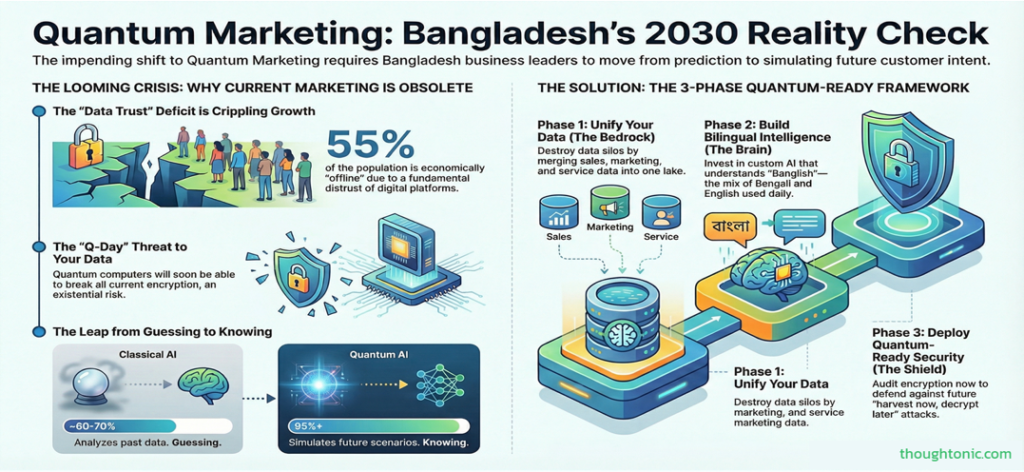
- The “Data Trust” Deficit Despite 133 million internet subscribers (BTRC/Wikipedia 2025), a staggering 55% of our population effectively remains “offline” in terms of meaningful economic participation. Why? They don’t trust the digital ecosystem. Global reports from Thales and DigiCert in 2024 highlight that consumer trust is at an all-time low. If your customer doesn’t trust your security, no amount of AI personalization will convert them.
- The Invisible “Q-Day” Threat This is where it gets interesting. While local marketers debate the color of a banner ad, Bangladeshi researchers at North South University (NSU) are preparing for “Q-Day” the hypothetical day when quantum computers become powerful enough to break all current encryption. For a fintech like bKash or a telco like Grameenphone, this isn’t science fiction; it’s an existential risk to their entire customer database.
The Science: From Prediction to “Entanglement”
To understand Quantum Marketing, you have to stop thinking about marketing as a “funnel” and start thinking about it as a “field.”
In classical computing (what we use now), a bit is either a 1 or a 0. You are either “in market” for a car, or you aren’t.
But in quantum computing, a “qubit” can be both 1 and 0 simultaneously (superposition).
What does this mean for a Marketing Director in Gulshan? It means that by 2030, your customer exists in a state of potential intent. They are both “buying” and “not buying” until you observe them with the right data.
- Classical AI: Analyzes past data to guess what you might do next. (Accuracy: ~60-70%).
- Quantum AI: Simulates millions of future scenarios in seconds to determine the exact incentive needed to trigger a purchase. (Accuracy: ~95%+).
The Framework: The Anticipatory Marketing Stack
If you want to survive the shift from 2025 to 2030, you cannot just “buy AI.” You need to build a stack that handles uncertainty.
Phase 1: Data Unification (The Bedrock)
- The Decision: You must destroy departmental silos. Sales, Marketing, and CS data must live in one “lake.”
- The Trade-off: This is painful and expensive now, but necessary.
- The Metric: Single Customer View (SCV) Accuracy. If you can’t see a customer’s complaint and their purchase history in the same second, you are already obsolete.
Phase 2: Bilingual Intelligence (The Brain)
- The Decision: Stop relying solely on generic English LLMs (Large Language Models). Invest in tools that understand “Banglish” the mix of Bengali and English that 72% of our smartphone users actually type.
- The Trade-off: Custom local AI models cost more than generic APIs.
- The Metric: Sentiment Accuracy. Can your AI detect sarcasm in a Bangla comment?
Phase 3: Quantum-Ready Security (The Shield)
- The Decision: Audit your data encryption now. Is it quantum-safe?
- The Mistake: Waiting until 2029. By then, “harvest now, decrypt later” attacks will have already compromised your data.
- The Metric: Digital Trust Score.
Case Studies: The Future is Already Here
Global Benchmark: Mastercard Mastercard isn’t waiting for 2030. They are partnering with quantum computing firms like D-Wave to optimize loyalty rewards. Instead of sending the same coupon to everyone, they use quantum annealing to calculate the perfect offer for millions of users simultaneously. The result? A level of hyper-personalization that feels like magic.
Local Pioneer: Grameenphone & The “Telco-Tech” Pivot Closer to home, look at Grameenphone’s 2024 transformation. They explicitly shifted their identity from a “mobile operator” to a “Telco-Tech” company. By leveraging AI-driven CRM for their 85 million+ subscribers, they are building the precursor to quantum marketing. They aren’t just selling talk time; they are using data to predict lifestyle needs. The limitation? They are still battling legacy infrastructure, a challenge every large Bangladeshi corp faces.
Action Plans: What You Do Monday Morning
For Organizations (The CXO Level)
- Budget for Failure: Allocate 10% of your marketing budget to “Moonshot Tech” (like VR or advanced NLP) knowing half of it will fail. That’s R&D, not waste.
- Hire an “Algorithmic Ethicist”: As you use AI to predict behavior, you risk manipulating vulnerable populations. In a market like Bangladesh, ethical missteps will invite harsh regulation.
- Prepare for “Agent Marketing”: By 2030, your customer won’t be a human; it will be their AI assistant. Optimize your SEO for machines, not eyes.
For Professionals (The Career Level)
- Learn the Logic, Not the Code: You don’t need to be a quantum physicist, but you must understand probability.
- Master “Prompt Strategy”: The ability to direct an AI to generate high-quality Bangla content will be a high-ticket skill.
- Get Comfortable with Data Privacy: Read the draft Data Protection Acts. Privacy is the new premium product.
Critical Perspective: The Reality Check
Here is the contrarian view no one likes to admit: Technology might not be the answer for everything.
In a culture as relationship-driven as Bangladesh, there is a risk of “over-automation.” If a high-net-worth client calls your bank and gets a hyper-intelligent AI instead of a human, you might lose them. The ultimate luxury in 2030 won’t be Quantum AI; it will be human empathy. The winning brands will use tech to empower their staff, not replace them.
Key Takeaways
- Trust is the new Oil: With 55% of the population wary of digital spaces, security is your best marketing asset.
- Bilingual is Non-Negotiable: If your AI can’t speak “Dhaka Urban” slang, it’s useless.
- Q-Day is Coming: Quantum computing research is active in BD (NSU). Encryption standards will change.
- The Agent Economy: Optimize for the AI assistant that makes the purchase, not just the human.
- Data Hygiene First: Don’t buy a Ferrari engine (Quantum/AI) and put it in a rickshaw (dirty data).
Read more articles:
Digital Literacy & Brand Purpose: How Education Drives Loyalty in Emerging MarketsGenerative AI in Bangladeshi Advertising: Opportunities, Ethical Risks & Implementation Guide 2025The Brain’s Buy Button: How Neuromarketing Taps into Consumer Decision-Making (Global & Bangladesh Insights)Beyond the Bot: The Empathy Mandate for AI-Driven Customer Service in Bangladesh: A Data-Driven RoadmapBuilding the AI-Powered Enterprise: Strategy, Foundations, and the Future Workforce
Bibliography
- Bangladesh Bureau of Statistics (BBS). (2025). ICT Application and Usage Survey 2024-25. Access Report
- Bangladesh Telecommunication Regulatory Commission (BTRC). (2025). Internet Subscribers in Bangladesh: 2025 Status Report. View Statistics
- DataReportal. (2024). Digital 2024: Bangladesh. Read Full Report
- Thales Group. (2024). 2024 Thales Consumer Digital Trust Index. View Insights
- DigiCert. (2024). State of Digital Trust Survey. Read Survey
- The Business Standard. (2023). NSU researchers secure $60k grant to develop quantum computing software. Read Article
- Grameenphone. (2024). Annual Report 2023-2024: The Pivot to Telco-Tech. Download Report
- Forbes. (2024). How AI Is Reshaping The Future Of Marketing. Read Article
- McKinsey & Company. (2023). Quantum computing in financial services: From theory to reality. View Analysis
- The Asian Business Review. (2024). The Evolution of bKash and Fintech in Bangladesh. Read Case Study
- APNIC. (2024). Bridging the digital divide in Bangladesh. Read Blog
- Notionhive. (2023). Digital Marketing Trends in Bangladesh: 2024 and Beyond. View Trends
- IBM. (2024). What is Quantum Safe Cryptography? Learn More
- Elitmind. (2024). Banking Hyper-Personalisation Platform Case Study. View Case




29 Responses
[…] More Articles: Quantum Marketing: How 2030’s Technologies Will Shatter Bangladesh’s Status QuoDigital Literacy & Brand Purpose: How Education Drives Loyalty in Emerging MarketsGenerative AI […]
[…] More Articles: Quantum Marketing: How 2030’s Technologies Will Shatter Bangladesh’s Status QuoDigital Literacy & Brand Purpose: How Education Drives Loyalty in Emerging MarketsGenerative AI […]
[…] More Articles: Quantum Marketing: How 2030’s Technologies Will Shatter Bangladesh’s Status QuoDigital Literacy & Brand Purpose: How Education Drives Loyalty in Emerging MarketsGenerative AI […]
[…] Quantum Marketing: How 2030’s Technologies Will Shatter Bangladesh’s Status QuoDigital Literacy & Brand Purpose: How Education Drives Loyalty in Emerging MarketsGenerative AI in Bangladeshi Advertising: Opportunities, Ethical Risks & Implementation Guide 2025The Brain’s Buy Button: How Neuromarketing Taps into Consumer Decision-Making (Global & Bangladesh Insights)Beyond the Bot: The Empathy Mandate for AI-Driven Customer Service in Bangladesh: A Data-Driven Roadmap […]
[…] articles: Quantum Marketing: How 2030’s Technologies Will Shatter Bangladesh’s Status QuoDigital Literacy & Brand Purpose: How Education Drives Loyalty in Emerging MarketsGenerative AI […]
[…] Quantum Marketing: How 2030’s Technologies Will Shatter Bangladesh’s Status QuoDigital Literacy & Brand Purpose: How Education Drives Loyalty in Emerging MarketsGenerative AI in Bangladeshi Advertising: Opportunities, Ethical Risks & Implementation Guide 2025The Brain’s Buy Button: How Neuromarketing Taps into Consumer Decision-Making (Global & Bangladesh Insights)Beyond the Bot: The Empathy Mandate for AI-Driven Customer Service in Bangladesh: A Data-Driven Roadmap […]
[…] Quantum Marketing: How 2030’s Technologies Will Shatter Bangladesh’s Status QuoDigital Literacy & Brand Purpose: How Education Drives Loyalty in Emerging MarketsGenerative AI in Bangladeshi Advertising: Opportunities, Ethical Risks & Implementation Guide 2025The Brain’s Buy Button: How Neuromarketing Taps into Consumer Decision-Making (Global & Bangladesh Insights)Beyond the Bot: The Empathy Mandate for AI-Driven Customer Service in Bangladesh: A Data-Driven Roadmap […]
[…] Quantum Marketing: How 2030’s Technologies Will Shatter Bangladesh’s Status QuoDigital Literacy & Brand Purpose: How Education Drives Loyalty in Emerging MarketsGenerative AI in Bangladeshi Advertising: Opportunities, Ethical Risks & Implementation Guide 2025The Brain’s Buy Button: How Neuromarketing Taps into Consumer Decision-Making (Global & Bangladesh Insights)Beyond the Bot: The Empathy Mandate for AI-Driven Customer Service in Bangladesh: A Data-Driven Roadmap […]
[…] Quantum Marketing: How 2030’s Technologies Will Shatter Bangladesh’s Status QuoDigital Literacy & Brand Purpose: How Education Drives Loyalty in Emerging MarketsGenerative AI in Bangladeshi Advertising: Opportunities, Ethical Risks & Implementation Guide 2025The Brain’s Buy Button: How Neuromarketing Taps into Consumer Decision-Making (Global & Bangladesh Insights)Beyond the Bot: The Empathy Mandate for AI-Driven Customer Service in Bangladesh: A Data-Driven Roadmap […]
[…] Quantum Marketing: How 2030’s Technologies Will Shatter Bangladesh’s Status QuoDigital Literacy & Brand Purpose: How Education Drives Loyalty in Emerging MarketsGenerative AI in Bangladeshi Advertising: Opportunities, Ethical Risks & Implementation Guide 2025The Brain’s Buy Button: How Neuromarketing Taps into Consumer Decision-Making (Global & Bangladesh Insights)Beyond the Bot: The Empathy Mandate for AI-Driven Customer Service in Bangladesh: A Data-Driven Roadmap […]
[…] Quantum Marketing: How 2030’s Technologies Will Shatter Bangladesh’s Status QuoDigital Literacy & Brand Purpose: How Education Drives Loyalty in Emerging MarketsGenerative AI in Bangladeshi Advertising: Opportunities, Ethical Risks & Implementation Guide 2025The Brain’s Buy Button: How Neuromarketing Taps into Consumer Decision-Making (Global & Bangladesh Insights)Beyond the Bot: The Empathy Mandate for AI-Driven Customer Service in Bangladesh: A Data-Driven Roadmap […]
[…] Quantum Marketing: How 2030’s Technologies Will Shatter Bangladesh’s Status QuoDigital Literacy & Brand Purpose: How Education Drives Loyalty in Emerging MarketsGenerative AI in Bangladeshi Advertising: Opportunities, Ethical Risks & Implementation Guide 2025The Brain’s Buy Button: How Neuromarketing Taps into Consumer Decision-Making (Global & Bangladesh Insights)Beyond the Bot: The Empathy Mandate for AI-Driven Customer Service in Bangladesh: A Data-Driven Roadmap […]
[…] Quantum Marketing: How 2030’s Technologies Will Shatter Bangladesh’s Status QuoDigital Literacy & Brand Purpose: How Education Drives Loyalty in Emerging MarketsGenerative AI in Bangladeshi Advertising: Opportunities, Ethical Risks & Implementation Guide 2025The Brain’s Buy Button: How Neuromarketing Taps into Consumer Decision-Making (Global & Bangladesh Insights)Beyond the Bot: The Empathy Mandate for AI-Driven Customer Service in Bangladesh: A Data-Driven Roadmap […]
[…] Costly Visual Search Blind Spot That Is Making Bangladesh Brands InvisibleQuantum Marketing: How 2030’s Technologies Will Shatter Bangladesh’s Status QuoDigital Literacy & Brand Purpose: How Education Drives Loyalty in Emerging MarketsGenerative AI […]
[…] Costly Visual Search Blind Spot That Is Making Bangladesh Brands InvisibleQuantum Marketing: How 2030’s Technologies Will Shatter Bangladesh’s Status QuoDigital Literacy & Brand Purpose: How Education Drives Loyalty in Emerging MarketsGenerative AI […]
[…] Costly Visual Search Blind Spot That Is Making Bangladesh Brands InvisibleQuantum Marketing: How 2030’s Technologies Will Shatter Bangladesh’s Status QuoDigital Literacy & Brand Purpose: How Education Drives Loyalty in Emerging MarketsGenerative AI […]
[…] Costly Visual Search Blind Spot That Is Making Bangladesh Brands InvisibleQuantum Marketing: How 2030’s Technologies Will Shatter Bangladesh’s Status QuoDigital Literacy & Brand Purpose: How Education Drives Loyalty in Emerging MarketsGenerative AI […]
[…] Costly Visual Search Blind Spot That Is Making Bangladesh Brands InvisibleQuantum Marketing: How 2030’s Technologies Will Shatter Bangladesh’s Status QuoDigital Literacy & Brand Purpose: How Education Drives Loyalty in Emerging MarketsGenerative AI […]
[…] Costly Visual Search Blind Spot That Is Making Bangladesh Brands InvisibleQuantum Marketing: How 2030’s Technologies Will Shatter Bangladesh’s Status QuoDigital Literacy & Brand Purpose: How Education Drives Loyalty in Emerging MarketsGenerative AI […]
[…] Costly Visual Search Blind Spot That Is Making Bangladesh Brands InvisibleQuantum Marketing: How 2030’s Technologies Will Shatter Bangladesh’s Status QuoDigital Literacy & Brand Purpose: How Education Drives Loyalty in Emerging MarketsGenerative AI […]
[…] Costly Visual Search Blind Spot That Is Making Bangladesh Brands InvisibleQuantum Marketing: How 2030’s Technologies Will Shatter Bangladesh’s Status QuoDigital Literacy & Brand Purpose: How Education Drives Loyalty in Emerging MarketsGenerative AI […]
[…] Design StrategyThe Costly Visual Search Blind Spot That Is Making Bangladesh Brands InvisibleQuantum Marketing: How 2030’s Technologies Will Shatter Bangladesh’s Status QuoDigital Literacy & Brand Purpose: How Education Drives Loyalty in Emerging MarketsGenerative AI […]
[…] Design StrategyThe Costly Visual Search Blind Spot That Is Making Bangladesh Brands InvisibleQuantum Marketing: How 2030’s Technologies Will Shatter Bangladesh’s Status QuoDigital Literacy & Brand Purpose: How Education Drives Loyalty in Emerging MarketsGenerative AI […]
[…] Quantum Marketing: How 2030’s Technologies Will Shatter Bangladesh’s Status Quo […]
[…] Quantum Marketing: How 2030’s Technologies Will Shatter Bangladesh’s Status Quo […]
[…] Quantum Marketing: How 2030’s Technologies Will Shatter Bangladesh’s Status Quo […]
[…] Quantum Marketing: How 2030’s Technologies Will Shatter Bangladesh’s Status Quo […]
[…] Quantum Marketing: How 2030’s Technologies Will Shatter Bangladesh’s Status Quo […]
[…] Quantum Marketing: How 2030’s Technologies Will Shatter Bangladesh’s Status Quo […]