The Proven Power of Purpose-Driven Marketing: Why Bangladesh Brands Must Lead with Impact
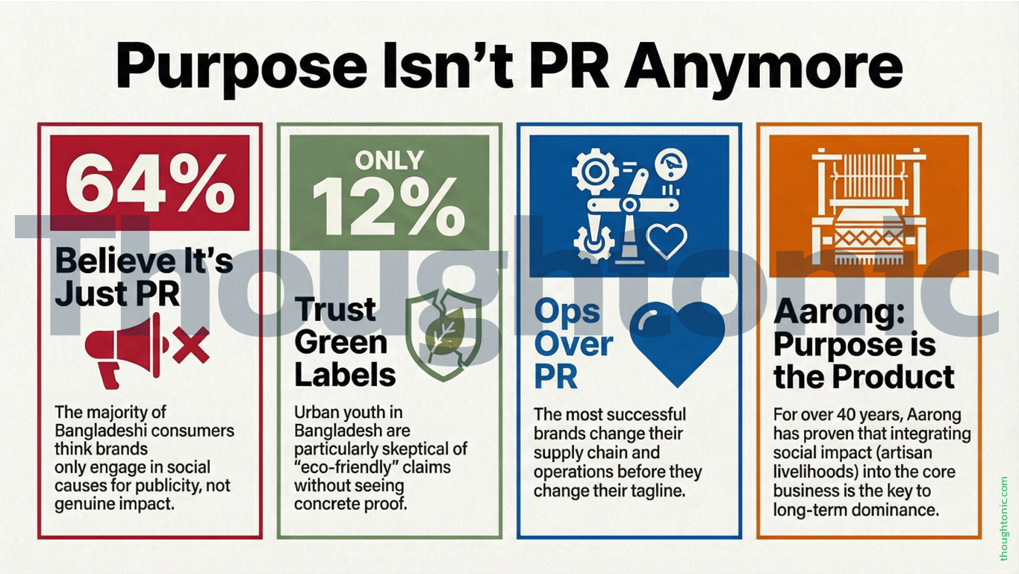
The “Dhaka logic” of branding is changing right under our feet. For a long time, we thought of social impact as something you do after you’ve made your profit, usually in the form of a giant check presented at a press conference. But here’s the thing: that old model is dying. Recent data from 2024 shows that nearly 64% of Bangladeshi consumers now believe brands only engage in social causes for the sake of PR. They’ve grown tired of the noise. If you want to build a brand that lasts in this economy, you have to move toward purpose-driven marketing that actually solves a problem for the person living in Mirpur or Chattogram. It isn’t about charity anymore. It’s about building a brand that people feel protective of because you’re doing something they care about.
The Brutal Reality of the Trust Deficit
In my analysis, the biggest threat to Bangladeshi brands isn’t the competition or even inflation. It’s the “trust gap.” We see this in the global data, but it’s magnified here. While global trust in brands has been wavering, local consumers are particularly skeptical because they’ve been burned by inconsistent quality and false claims for decades.
A study from the Yale Program on Climate Change Communication in late 2024 found that only 12% of urban youth in Bangladesh trust “eco-friendly” labels without seeing the proof. This means if you’re using purpose-driven marketing as a veneer, you’re not just wasting money; you’re actively damaging your reputation. When a brand claims to be “green” but their supply chain in Gazipur is still dumping waste, the internet finds out. And in our high-context culture, a “performative” label is a death sentence for a brand’s premium pricing power.
Why Purpose-Driven Marketing is the New Survival Strategy
Let’s look at the science of why this works. Human beings are hardwired to support those who support them. In a country like Bangladesh, where institutional support can be thin, brands often step in to fill the void. This isn’t just “feel-good” stuff; it’s about creating “Brand Salience.”
When you align your business goals with a social friction point—be it traffic, plastic waste, or women’s financial independence—you move from being a commodity to being a partner. This shift reduces your customer acquisition cost over the long haul. Why? Because loyalists do your marketing for you. But this only happens when the purpose is baked into the product. This is where it gets interesting: the most successful brands don’t just talk about the problem; they change their operations to solve it.
The Impact Integration Framework
If you’re a CXO looking to move beyond the “CSR check-box,” you need a system. Here is a 4-step framework that actually works in the local context.
| Step | Leadership Action | The Trade-off | Success Metric |
| Audit Operations | Identify your biggest “negative” impact (e.g., waste). | You might have to cut a cheap, unethical supplier. | ESG Risk Score |
| Narrow the Focus | Choose ONE local issue to own completely. | You must ignore other “trendy” causes. | Share of Voice in Niche |
| Embed the Impact | Make the solution part of the product. | Higher R&D costs upfront. | Repeat Purchase Rate |
| Radical Honesty | Share the “messy middle” of your progress. | Vulnerability to critics. | Brand Sentiment |
Case Studies: From Global Giants to Local Legends
We can learn a lot from how Patagonia handles its brand. They famously told customers, “Don’t Buy This Jacket” to discourage over-consumption. Most marketers thought they were crazy. But the result? Their revenue grew to $1.5 billion because people wanted to buy from a company that actually had a spine.
Closer to home, look at Aarong. It’s arguably the most successful example of purpose-driven marketing in the history of Bangladesh. For over 40 years, they’ve tied high-end retail to the livelihoods of 65,000 artisans. They didn’t just run an ad about helping the poor; they built a supply chain that made “helping” a byproduct of buying a beautiful Panjabi. The limitation, of course, is that scaling this model is incredibly hard. You can’t mass-produce “soul.” But for decades, they’ve maintained a dominant market share because their purpose is their product.
Action Plan: Moving from Talk to Task
The reality is more nuanced than just “being good.” You have to be strategic.
For Organizations
- Redirect the Budget: Move 30% of your traditional ad spend into “Product-as-a-Service” or social impact R&D.
- The 2-Year Rule: Commit to one social cause for at least 24 months. Anything less is just a campaign, not a purpose.
- Supplier Re-contracts: High effort, but necessary. Ensure your “impact” doesn’t stop at your office door.
For Professionals
- Learn the Logistics: You can’t be a purpose-led marketer if you don’t understand how your product is made.
- Master Data Ethics: How you handle customer data is the next big social impact frontier in Bangladesh.
- Practice Radical Honesty: Tell your CEO that the “Earth Day” post with no action behind it is a liability, not an asset.
The Contrarian View: When to Say Nothing
I want to be clear: sometimes, the best thing a brand can do is stay quiet. If your product is struggling or your internal culture is toxic, launching a “purpose” campaign is like putting a silk tie on a pig. In some scenarios, being a boring, honest, tax-paying company that treats its employees well is a bigger social impact than any PR stunt. Don’t fall into the trap of “impact fatigue.” If you don’t have the stomach for the trade-offs, don’t play the game.
Key Takeaways
- Purpose is a hedge: It protects your brand during economic downturns.
- Local focus wins: Solving a Dhaka problem is better than solving a “Global” one.
- 64% of locals are skeptics: You have to prove it, not just say it.
- Ops over PR: Change your supply chain before you change your tagline.
- Gen Z is watching: They prioritize “purpose-led” employers and brands.
- Aarong is the blueprint: Integration of impact is the key to 40+ years of dominance.
Read More Articles:
Digital Literacy & Brand Purpose: How Education Drives Loyalty in Emerging MarketsGenerative AI in Bangladeshi Advertising: Opportunities, Ethical Risks & Implementation Guide 2025The Brain’s Buy Button: How Neuromarketing Taps into Consumer Decision-Making (Global & Bangladesh Insights)Beyond the Bot: The Empathy Mandate for AI-Driven Customer Service in Bangladesh: A Data-Driven RoadmapBuilding the AI-Powered Enterprise: Strategy, Foundations, and the Future Workforce
Bibliography
- LightCastle Partners – Consumer Sentiment Report 2024
- Bangladesh Bank – CSR Activities in Financial Sector 2023
- Yale Program on Climate Change – Bangladesh Survey 2024
- The Daily Star – The Rise of Conscious Consumerism in Dhaka, 2024
- Dhaka Tribune – How Social Enterprises are Shaping the New Economy, 2025
- Kantar – Media Trends and Consumer Behavior 2024
- Nielsen – The Sustainability Imperative Global Report
- Harvard Business Review – The Truth About CSR, 2023
- BRAC – Annual Report on Social Enterprises 2024
- BBS – Statistical Yearbook of Bangladesh 2023
- Forbes – The Evolution of Purpose-Led Brands
- World Bank – Bangladesh ESG Risk Assessment 2024
- Unilever – Sustainable Living Report (Bangladesh Chapter) 2024
- BSRM – Corporate Social Responsibility Sustainability Report 2023
- Business Standard – Marketing to the Bangladeshi Gen Z, 2024