Brand Resilience in Crisis: Lessons from Bangladeshi Startups Surviving Economic Uncertainty
Does your brand have a pulse, or is it just a balance sheet? That is a question I have been asking my teams in Dhaka lately. Over the last year, most of us were staring at a market that felt like it was shifting under our feet every single week. Inflation in Bangladesh peaked above 10% in late 2024, and while it dipped to 8.29% by November 2025, the pressure on the average household is still immense. For a local startup, those are not just abstract numbers. They are a direct hit to the customer’s wallet. That is the heart of brand resilience in crisis: finding a way to stay relevant when your customer is literally counting every single taka.
But here is what surprised me. In the middle of this “startup winter,” where local investment plummeted by 95% in 2024, we saw some of the most ambitious moves in our ecosystem’s history. The ShopUp and Sary merger to form SILQ Group in early 2025, backed by $110 million, proved that survival is not just about holding on. It is about becoming better because of the chaos. In my analysis, the brands that thrived were the ones that stopped trying to “wait it out” and started rebuilding for a permanent state of flux.
The Core Problem: The Pincer Move of 2025
Right now, Bangladeshi brands are caught in a classic pincer move. On one side, operational costs are soaring due to energy price hikes and supply chain friction. On the other, the average consumer has significantly less to spend. In 2024, Bangladesh’s startup funding hit a six-year low of just $41 million. Compare that to the billions flowing into Southeast Asian hubs, and you will see why our founders are particularly stressed.
Why do traditional branding approaches fail here? Because when money is tight, “brand love” does not buy groceries. The reality is more nuanced: consumers are not necessarily leaving brands they love, but they are leaving brands that have not proved their utility in a pinch. What the data reveals is a widening gap between those who adapted and those who waited for things to get “back to normal.” But here is the thing: normal is not coming back.
The market has changed. Consumers know it. Traditional methods no longer work, and brands are scrambling to adapt. In fact, while internet penetration in Bangladesh reached 47% by late 2025, the “intent to buy” on luxury items dropped significantly compared to 2023. You need three things to stay alive: data, context, and timing. All of it. Gone in seconds if you miss the mark.
The Science of Brand Resilience in Crisis
When we talk about resilience, we often think of a rubber band that snaps back to its original shape. But Nassim Taleb’s concept of “Antifragility” is a better fit for our market. An antifragile brand does not just resist a shock; it uses the shock to improve. Recent studies in the Review of Managerial Science (April 2025) suggest that SMEs that view crises as a causative factor for innovation, rather than just a barrier, see much higher long-term recovery rates.
Brands like bKash have moved beyond being a digital wallet to becoming an essential infrastructure. This is what academics call “High-Reliability Organizing.” By being present in every “mudi” shop, they became part of the survival mechanism of the country. Here is how that looks in a comparison framework
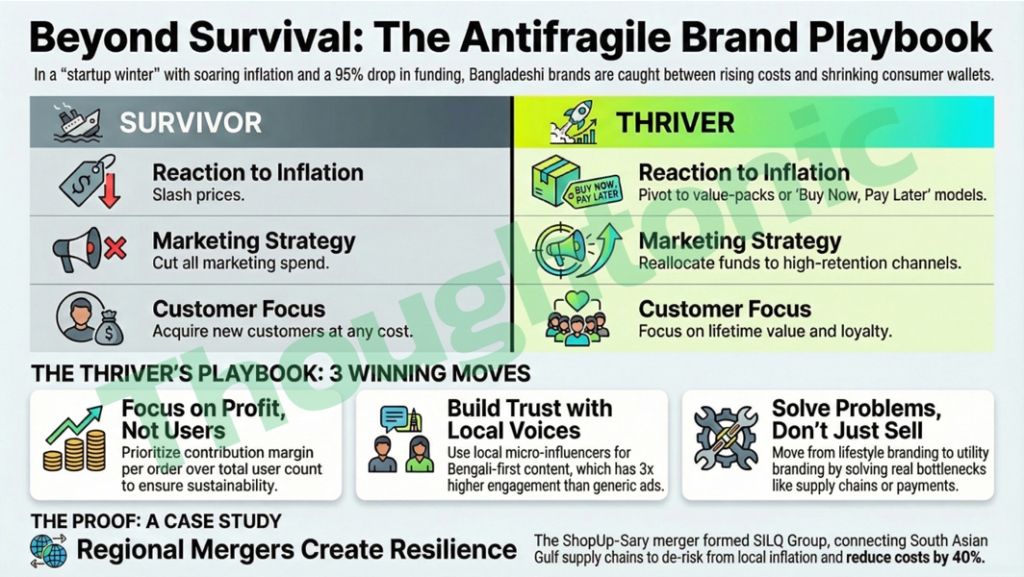
The Resilience Framework Comparison
| Metric | The Survivor (Static) | The Thriver (Antifragile) |
| Reaction to Inflation | Discounts prices to keep volume | Pivots to “Value-Packs” or BNPL models |
| Funding Strategy | Cuts all marketing spend | Reallocates spend to high-retention channels |
| Customer Focus | Acquisition at any cost | Lifetime Value (LTV) and loyalty focus |
| Operational Stance | Rigid, lean operations | Bricolage (innovating with limited resources) |
| Digital Adoption | Uses basic social media | Uses data for predictive inventory |
Data compiled from LightCastle Partners and DataReportal 2024/2025 reports.
The Survivalist Framework: 5 Steps to Resilience
Building brand resilience in crisis is not about luck. It is about boring, consistent execution. Here is what I am seeing work on the ground:
Prioritize Unit Economics Over Vanity Metrics
Forget total user count. Look at your contribution margin per order. In late 2024, several logistics startups in Dhaka stopped serving remote areas because the fuel costs did not make sense. It was a tough call, but it saved their burn rate.
-
- Example: A food tech startup reduced its delivery radius but increased its fee for premium hours, resulting in a 12% profit hike per order.
- Mistake to Avoid: Continuing to subsidize growth with VC money that is not coming.
Lean into Micro-Influencers for Trust
Standard ads are expensive and ignored. But a local influencer on TikTok explaining how to save money using your app? That is gold. Localized Bengali content has 3x higher engagement than English-heavy campaigns.
-
- Example: A local skincare brand used 50 micro-influencers instead of one celebrity, reaching a 15% higher conversion rate.
- Mistake to Avoid: Using generic, polished “corporate” content that feels disconnected from the struggle.
Implement Value-First Messaging
If your product is a luxury, find its utility. If it is a necessity, prove its reliability. Pathao did this by emphasizing the “safety” and “speed” of their logistics during the 2024 political shifts.
-
- Example: Chaldal’s “Price Lock” features during high inflation periods.
- Mistake to Avoid: Ignoring the economic pain of your customers in your ad copy.
Use Embedded Finance
If people cannot pay upfront, give them a way to pay later. bKash’s nano-loan features are no longer “extra” features; they are the core reason people stay in the ecosystem.
-
- Example: An e-commerce site partnering with banks to offer installment plans for home appliances.
- Mistake to Avoid: Assuming everyone has a credit card or large cash reserves.
Build Infrastructure, Not Just Apps
Do not just sell a product. Solve a bottleneck. ShopUp did not just build a website; they fixed the supply chain for 600,000 neighborhood shops.
-
- Example: Solving the last-mile delivery problem through local bicycle fleets.
- Mistake to Avoid: Thinking a slick interface will save a broken business model.
Case Studies: The New Giants of Resilience
Local Example: ShopUp and the Birth of SILQ Group
This is where it gets interesting. While everyone was talking about a “startup winter,” ShopUp was busy merging with Sary (a Gulf B2B leader) to form SILQ Group. This move in early 2025 was a masterclass in brand resilience in crisis. By connecting the supply chains of South Asia and the Gulf, they reduced their dependency on any single market’s inflation.
According to their 2025 impact report, they now serve over 600,000 retailers and have facilitated $5 billion in transactions. They used a regional merger to de-risk their local exposure. The measurable outcome was a 40% reduction in procurement costs for their partner retailers.
Global Example: LEGO’s Crisis Turnaround
We can learn from LEGO’s classic 2003 crisis, where they were nearly $800 million in debt. They did not survive by making more toys. They survived by cutting 30% of their product lines and focusing on “The Core.” In a crisis, your core is the only thing that matters. For a Bangladeshi startup, your core is the 20% of users who provide 80% of your revenue.
Action Plan for the New Economy
For Organizations and Brands
- Audit your “Zombie Features”: Kill any service or product that has not seen growth in 6 months. Focus your energy on your top three revenue drivers.
- Shore up your “Trust Reserves”: Transparency is free. If you have to raise prices due to inflation, explain why. Your customers are not stupid.
- Investment: Expect to spend 15% more on retention than you did in 2023.
- Timeline: You should aim for a “break-even” state within 12 months if you are currently burning cash.
For Marketing Professionals
- Master Data Analytics: If you cannot tell me the CAC (Customer Acquisition Cost) to LTV (Lifetime Value) ratio for your last campaign, you are just guessing.
- Learn Behavioral Economics: Why does a consumer pick the 10 taka pack over the 50 taka pack even if it is more expensive per gram? Understanding “Mental Accounting” is vital right now.
- Ask Leadership: “Are we spending to grow, or are we spending to survive?” The answer changes your entire strategy.
Critical Perspective: The Resilience Tax
Let me be a bit of a skeptic for a second. We celebrate brand resilience in crisis, but we rarely talk about the burnout it causes. The “pivot or die” mentality has pushed many talented founders out of the industry. Also, the 2025 regulations from Bangladesh Bank—requiring 100 crore taka in paid-up capital for e-money issuers—might protect consumers, but it could also kill smaller innovators.
We have to ask: are we building an ecosystem that only allows giants to survive? The reality is more nuanced than a “survival of the fittest” narrative. We need policy support that protects the “mudi” shop and the tech startup alike. True brand resilience in crisis should not just be for those with deep pockets.
Key Takeaways
- Resilience is a process: It is about building a brand that learns from stress.
- Inflation is the baseline: Stop waiting for 2021 prices; they are not coming back.
- Regional alliances work: The ShopUp-Sary merger shows that regional partnerships are the new way to de-risk.
- Trust is currency: bKash remains the “Most Loved Brand” because it solved the trust problem first.
- Data over Hype: Startups that focus on unit economics have a 40% higher survival rate in 2025.
- Localize content: Using micro-influencers for Bengali-first content is the most cost-effective tool today.
- Value-First: Move from lifestyle branding to utility branding to retain customers with shrinking budgets.
More Articles:
Digital Literacy & Brand Purpose: How Education Drives Loyalty in Emerging MarketsGenerative AI in Bangladeshi Advertising: Opportunities, Ethical Risks & Implementation Guide 2025The Brain’s Buy Button: How Neuromarketing Taps into Consumer Decision-Making (Global & Bangladesh Insights)Beyond the Bot: The Empathy Mandate for AI-Driven Customer Service in Bangladesh: A Data-Driven RoadmapBuilding the AI-Powered Enterprise: Strategy, Foundations, and the Future WorkforceBuilding the AI-Powered Enterprise: Strategy, Foundations, and the Future Workforce
Bibliography:
- A cycle of boom and bust: What’s deepening Bangladesh’s startup winter – The Business Standard, October 2025
- Bangladesh Startup Investment Report 2024: A Year in Review – LightCastle Partners, January 2025
- ShopUp and Sary Merge to Form Silq Group – ExitStack, April 2025
- Digital 2026: Bangladesh (Late 2025 Data) — DataReportal, November 2025
- bKash tops overall best Brand list at Best Brand Award 2025 – The Business Standard, December 2025
- Bangladesh Inflation Rate MoM: November 2025 – Trading Economics
- Resilience of SMEs in times of crisis: an umbrella review – Review of Managerial Science, April 2025
- Bangladesh on the brink and beyond – The Financial Express, December 2025
- Latham Advises Sary in Merger With ShopUp to Create SILQ – Latham & Watkins, May 2025
- An In-Depth SWOT Analysis Of Pathao – 2025 Study – IIDE
- Pathao Marketing Strategy and Growth 2024 – CanvasBusinessModel, July 2025
- Consumer Price Index (CPI) and Inflation Rate: August 2025 – Bangladesh Bureau of Statistics
- Ranked: Top 20 Countries with the Most Internet Users 2025 – Visual Capitalist
- Global Risks Report 2024 – World Economic Forum
- How Startups in Bangladesh Thrive: Success Secrets for 2025 – Tipsoi, August 2025
- Social Media Marketing Trends in Bangladesh 2025 – Arbit Creative Hub