Augmented Reality for Local Brands: Bringing Physical Products to Digital Experiences in Bangladesh
Augmented reality for local brands: Your customer walks into a furniture showroom, falls in love with a sofa, purchases it, waits three weeks for delivery—and then realizes it clashes with their carpet. The sofa goes back. You’ve lost ৳50,000 in revenue and another ৳15,000 in logistics. This happens daily across Dhaka, and it’s costing brands millions.
What if your customer could see that sofa in their living room before ordering? Not a flat photo. Not a catalog sketch. But a life-sized, 3D model sitting right where they’d place it, viewed through their phone. That’s not future tech. It’s here now, and brands from IKEA to Sephora are already banking on it.
The Numbers Tell a Different Story
The global AR (augmented reality) retail market was valued at $6.68 billion in 2024 and is projected to reach $93.07 billion by 2032, growing at a staggering 43% annually. But here’s what matters for Bangladesh: mobile AR specifically hit $37.73 billion in 2024 and will reach $529.93 billion by 2034—a 30% annual growth rate driven entirely by smartphones.
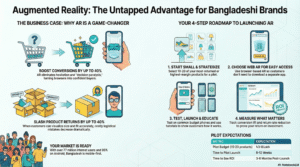
Why does this matter? Because 95% of Bangladeshi mobile users are on Android, and 77.36 million people in Bangladesh had internet access in early 2024. Your market is already device-ready. Bangladesh’s e-commerce market reached $9 billion in 2024 and will hit $13 billion by 2027. Mobile commerce dominates, and consumers are searching for ways to bridge the confidence gap between browsing and buying.
Compare this with global adoption rates: 61% of consumers prefer retailers offering AR experiences, and 71% would shop more frequently at stores that implement AR. 32% of consumers already incorporate AR into their shopping routine, with Gen Z showing 94% interest in AR furniture placement.
Regional markets are racing ahead. India’s AR adoption in retail is accelerating, with a 2024 study across 15 retail outlets in four Indian metro cities finding AR significantly affects both utilitarian and hedonic value perceptions. Indonesia and Southeast Asian markets are following similar trajectories. Bangladesh can’t afford to lag—not when your competitors across the border are already testing these waters.
The Science Behind Why AR Works
The mechanism is surprisingly simple. Point your phone camera at a space. The AR software analyzes depth, surfaces, and lighting in real-time using computer vision algorithms. Then it places a 3D model of your product—scaled accurately—into that space. The customer moves around. They see angles. They understand fit.
But the psychology runs deeper. Research from Deloitte found that interactive AR experiences boost sales conversion rates by up to 40%. Here’s why: decision paralysis. When customers can’t visualize a product in context, they hesitate. That hesitation translates to abandoned carts and returned merchandise.
AR reduces product return rates by 40% and increases conversions by 30-40% for virtual try-on implementations. The financial impact is immediate. If your furniture brand processes 100 orders monthly with a 25% return rate, AR could cut that to 15%. That’s 10 fewer returns—savings of ৳500,000 in logistics and restocking.
The data gets more specific. Sephora’s AR mirror trials led to a 31% increase in sales, with AR try-on users showing conversion rates up to 90% higher than non-users. Sephora Turkey saw a 35% increase in online makeup sales after implementing AR try-on, alongside a 25% increase in add-to-basket rates.
For furniture specifically, IKEA’s Place app achieved 8 million downloads and extended average browsing time from three to eight minutes. More critically, IKEA reduced their return rate by 30%—a massive operational win.
Here’s the framework for understanding AR’s impact:
| Metric | Without AR | With AR | Impact |
| Conversion Rate | Baseline | +30-40% | Higher purchase confidence |
| Return Rate | Baseline | -25-40% | Better product understanding |
| Browsing Time | 3 minutes | 8 minutes | Deeper engagement |
| Cart Addition | Baseline | +25-44% | Increased intent |
| Customer Satisfaction | Baseline | +20-31% | Reduced post-purchase regret |
The mechanism works because AR eliminates the imagination tax. Customers don’t have to mentally project a 2D image into their 3D space. The technology does it for them.
Your Implementation Roadmap: 7 Steps to AR Integration
Step 1: Audit Your Product Catalog (2 weeks)
Identify which products benefit most from AR visualization. Furniture, home décor, fashion accessories, and FMCG packaging all work well. Start with your highest-margin or most-returned items.
Example: A Bangladeshi furniture brand analyzed return data and found sectional sofas and dining sets accounted for 40% of returns due to size mismatches. They prioritized these for AR development first.
Common mistake: Trying to AR-enable your entire catalog at once. Start with 10-20 hero products. Test. Learn. Scale.
Step 2: Create 3D Product Models (3-4 weeks)
You’ll need accurate 3D models of your products. Options include photogrammetry (taking multiple photos from different angles), 3D scanning services, or manual 3D modeling.
Budget expectation: Professional 3D modeling costs $100-500 per product depending on complexity. Photogrammetry services run $50-200 per item. For a 20-product pilot, budget $4,000-8,000.
Example: Aarong could start with 15 signature furniture pieces—bed frames, dining tables, decorative items—and create models through a local 3D scanning partner.
Common mistake: Low-quality models that don’t accurately represent textures, colors, or scale. Customers notice immediately and trust evaporates.
Step 3: Choose Your AR Platform (1-2 weeks)
For mobile-first markets like Bangladesh, you have several options:
- Web AR: Works directly in mobile browsers without app downloads. Tools like Shopify AR, 8th Wall, or Zakeke integrate with existing e-commerce sites.
- Social media AR: Instagram and Facebook offer AR try-on capabilities through their camera features.
- Dedicated apps: Build your own AR app using ARCore (Android) or ARKit (iOS).
For most Bangladeshi brands, Web AR makes the most sense initially. With less than 1% of Bangladesh retail transactions happening through e-tailers, you need solutions that work where customers already are—your website and social platforms.
Example: A local eyewear brand could use Web AR embedded on their product pages, allowing customers to virtually try on frames without downloading anything.
Common mistake: Building a standalone AR app when customers won’t download it. Unless you’re an established brand with millions in marketing budget, stick with Web AR.
Step 4: Integrate with Your E-commerce Platform (2-3 weeks)
Most modern e-commerce platforms (Shopify, WooCommerce, Magento) offer AR plugins or integration options. Your developer adds AR viewing buttons to product pages.
Technical requirement: Your website needs to be mobile-responsive (it should be already) and able to handle 3D model files (typically under 5MB each).
Example: Chaldal could add AR visualization for kitchen appliances and home goods, showing customers exactly how a mixer grinder or water purifier fits on their counter.
Common mistake: Poor mobile optimization. If your AR loads slowly on 4G connections, customers abandon. Test extensively on actual Bangladesh internet speeds.
Step 5: Test with Real Users (2 weeks)
Before full launch, recruit 50-100 customers to test your AR experience. Watch them use it. Note friction points. Is scaling accurate? Do colors match? Does it load quickly enough?
This testing phase prevents embarrassing launch failures and builds word-of-mouth.
Example: Bata Bangladesh could invite loyalty program members to test AR shoe try-ons, gathering feedback on fit visualization and interface usability.
Common mistake: Only testing on high-end devices. Make sure your AR works on budget Android phones—that’s your primary market.
Step 6: Launch with Education (2 weeks)
Customers won’t use AR if they don’t know it exists or understand how. Create tutorial videos, in-store demonstrations, and social media content showing the feature in action.
When Sephora SEA promoted their Virtual Artist feature to users who’d viewed makeup products in the past 30 days, they saw a 28% increase in AR adoption rates.
Example: Hatil could create Facebook videos showing families using AR to place furniture in their homes, emphasizing the “try before you buy” message in Bengali.
Common mistake: Assuming the technology is self-explanatory. Bangladeshi consumers need education and reassurance that AR is simple and trustworthy.
Step 7: Measure and Optimize (Ongoing)
Track key metrics: AR feature usage rates, conversion rates for AR vs. non-AR users, return rates, and customer feedback. Iterate based on data.
Set up analytics to monitor: How many customers click the AR button? How long do they engage? What percentage convert after using AR? Which products see the highest AR usage?
Example: After three months, review which furniture pieces customers engage with most via AR. Double down on those categories and add similar products.
Common mistake: Launching and forgetting. AR requires continuous optimization—updating models, improving load times, adding new products.
Real-World Proof: Brands That Made It Work
Global Case: IKEA Place
IKEA’s AR catalog app was downloaded 8.5 million times, allowing customers to visualize over 2,000 products in their homes. The company reported a 30% reduction in product returns and increased browsing time from three to eight minutes.
The innovation wasn’t just the AR—it was the integration. IKEA made AR accessible through both app and web, ensuring maximum reach. They continuously updated their product library and improved accuracy based on customer feedback.
The lesson for Bangladesh: Start simple but think systematically. IKEA didn’t AR-enable everything at once. They focused on furniture categories with high return rates and gradually expanded.
Regional Case: Myntra (India)
Myntra’s chief product and technology officer highlighted the growing relevance of AR/VR technology, especially for fashion and beauty in India. The platform rolled out virtual try-on for sunglasses, makeup, and accessories.
The cultural adaptation matters here. Indian consumers, like Bangladeshis, are value-conscious and return-averse (returns are logistically complicated). Myntra positioned AR as a money-saving tool—”See how it looks before you order”—which resonated strongly.
The lesson: Frame AR through the lens of practical benefits, not tech novelty. Bangladeshi consumers care about avoiding mistakes and wasting money. Your messaging should emphasize confidence and convenience.
Emerging Bangladesh Example: Daraz and Local Brands
While comprehensive case studies from Bangladesh are still emerging, several forward-thinking brands are testing waters. Local furniture brands are partnering with AR development agencies to create Web AR experiences, and fashion retailers are exploring social media AR filters.
An Indian furniture retailer developed an AR app to help merchant partners showcase products, using mobile phones to let customers juxtapose furniture with room ambience. Similar opportunities exist for Bangladeshi brands willing to pioneer.
The lesson: First-mover advantage is still available in Bangladesh. Be the brand that customers associate with innovative, customer-friendly shopping.
Your Action Plan Based on Business Type
For Organizations & Brands
Immediate Actions:
- Assign a cross-functional team (marketing, IT, product) to evaluate AR feasibility within 30 days
- Budget ৳3-8 lakh for a 15-20 product pilot program
- Select 3-5 high-return or high-margin products for initial AR development
- Partner with local AR development agencies or platforms like Shopify AR
Investment Framework:
- Small pilot (10-15 products): ৳3-5 lakh
- Medium deployment (30-50 products): ৳8-15 lakh
- Full integration (100+ products): ৳20-40 lakh
Timeline Expectations:
- Pilot launch: 8-12 weeks from decision
- Full rollout: 6-9 months
- ROI visibility: 3-6 months post-launch
Success Metrics to Track:
- AR feature engagement rate (target: 15-25% of product page visitors)
- Conversion rate lift for AR users vs. non-users (target: +20-30%)
- Return rate reduction (target: -15-25%)
- Average order value change (target: +10-15%)
For Marketing Professionals
Skills to Develop:
- 3D content basics (understanding formats like GLTF, USDZ)
- AR platform literacy (Shopify AR, 8th Wall, Spark AR for Facebook/Instagram)
- Customer experience design for spatial computing
- Analytics interpretation for AR-specific metrics
Tools to Learn:
- Canva’s 3D design features (basic)
- Blender or SketchUp (intermediate 3D modeling)
- Google’s Model Viewer (embedding 3D models on web)
- Analytics platforms with AR tracking (Google Analytics 4 with custom events)
Questions to Ask Leadership:
- “Which product categories have our highest return rates and why?”
- “What percentage of our customers shop primarily on mobile?”
- “Can we allocate ৳5 lakh for a 90-day AR pilot?”
- “Who are our direct competitors regionally, and what technology are they using?”
Career Positioning: Position yourself as the AR champion in your organization. Attend webinars on retail innovation, follow brands like IKEA and Sephora, and build a business case document showing potential ROI. In 2-3 years, AR literacy will be as expected as social media proficiency is today.
For Students/Entry-Level Professionals
Learning Resources:
- Free Courses:
- Google’s AR/VR Development Fundamentals (Coursera)
- Unity Learn: AR Foundation tutorials
- Meta Blueprint: AR Studio courses for Instagram/Facebook AR
- Paid Certifications:
- Udemy: Complete AR Development with Unity ($15-30)
- LinkedIn Learning: AR for Marketing and Advertising ($30/month)
- Coursera: XR and Immersive Technologies specialization ($50/month)
- Hands-On Practice:
- Download Spark AR Studio and create simple Instagram filters
- Use Shopify’s AR features (free trial available) to experiment with product visualization
- Create portfolio pieces showing AR concepts for local Bangladeshi brands
Portfolio-Building Activities:
- Create a mock AR experience for a local brand (Aarong, Bata, Yellow)
- Design a presentation showing how AR could reduce returns for a specific product category
- Build a simple Web AR demo using free tools and showcase it on your personal website
- Write case study analyses of IKEA Place or Sephora Virtual Artist with Bangladesh adaptation recommendations
Career Positioning: In your CV, include: “AR/VR Technology Enthusiast” as a skill section. In interviews, demonstrate understanding of how emerging tech solves business problems. Connect your AR knowledge to practical outcomes like conversion rate optimization and return reduction. Brands hiring for digital marketing, e-commerce, or product roles increasingly value candidates who understand spatial computing.
The Critical Perspective: What They Don’t Tell You
Let’s talk about what can go wrong, because the AR hype often glosses over real challenges.
Challenge 1: Technical Barriers
In a 2024 US survey, 18% of consumers cited technical issues or glitches as their top challenge when using AR for online shopping, and 42% stated they’d never tried using the technology. If this is true in developed markets with faster internet, Bangladesh faces even steeper hurdles.
Poor 4G coverage in Dhaka suburbs means AR experiences load slowly or fail. Budget Android phones (which dominate our market) sometimes struggle with complex 3D rendering. These aren’t trivial issues—they’re deal-breakers.
Challenge 2: The Cost Reality
High-quality AR devices and creating immersive content demands specialized skills and resources, leading to high development expenses that deter many retailers, especially small and medium-sized businesses. While Web AR is more affordable than custom apps, you’re still looking at ৳3-8 lakh minimum for a credible pilot.
For a small furniture workshop in Mirpur or a boutique clothing brand, that’s a significant investment with uncertain returns. Many local brands operate on razor-thin margins and can’t afford to experiment.
Challenge 3: Consumer Skepticism
User experience issues caused by bulky hardware and technical glitches represent 26% of obstacles to mass AR adoption, while consumer and business reluctance accounts for 14%. Bangladeshi consumers, in particular, may be wary of technology they don’t understand. Cultural trust barriers exist.
There’s also the “showrooming” risk: customers use your AR experience to visualize products, then purchase from a cheaper competitor who doesn’t offer AR. You’ve invested in the tech but captured no value.
Challenge 4: Maintenance Overhead
AR isn’t set-and-forget. You need to continuously update 3D models as products change, optimize for new devices, fix bugs, and respond to customer feedback. Integrating AR into existing retail systems requires investment in infrastructure and employee training, adding to the financial burden.
This ongoing cost often isn’t factored into initial budgets. Six months post-launch, brands realize they need dedicated resources just to maintain the AR experience.
The Balanced Truth:
AR isn’t right for every business, at least not yet. If you’re a hyperlocal brand with minimal e-commerce presence and customers who strongly prefer in-person shopping, AR may not deliver ROI. If your products are simple commodities (basic groceries, stationery), visualization doesn’t add much value.
But for furniture, fashion, home décor, beauty, and specialty FMCG with visual differentiation, AR is transitioning from “nice to have” to competitive necessity. The question isn’t whether to adopt AR—it’s when and how strategically to do it.
Don’t chase AR because it’s trendy. Chase it because your return rate is eating your margins and your customers are telling you they need more confidence before buying. That’s when AR makes business sense.
Key Takeaways
- Market momentum is undeniable: Global AR in retail will grow from $6.68 billion (2024) to $93.07 billion (2032) at 43% annual growth, with mobile AR driving accessibility in markets like Bangladesh
- Conversion and return impact: AR implementations deliver 30-40% conversion rate increases and 25-40% return rate reductions, directly improving profitability
- Bangladesh is AR-ready: With 77.36 million internet users, 95% on Android, and a $9 billion e-commerce market growing to $13 billion by 2027, the infrastructure exists for mobile AR adoption
- Start focused, not broad: Prioritize 10-20 high-return products for initial AR development rather than attempting catalog-wide implementation; IKEA and Sephora both scaled gradually
- Budget realistically: Small pilots cost ৳3-8 lakh, medium deployments ৳8-15 lakh; factor in ongoing maintenance and optimization expenses beyond launch
- Measure what matters: Track AR engagement rates, conversion lift, return rate reduction, and customer feedback—not just vanity metrics like downloads or views
- Education is non-negotiable: Targeted user education can increase AR adoption rates by 28%; assume nothing is self-explanatory to Bangladesh consumers
- Technical challenges are real: 18% of users face technical glitches, and 42% never try AR even in developed markets; optimize relentlessly for slow internet and budget devices
Read more:
Generative AI in Bangladeshi Advertising: Opportunities, Ethical Risks & Implementation Guide 2025The Brain’s Buy Button: How Neuromarketing Taps into Consumer Decision-Making (Global & Bangladesh Insights)Beyond the Bot: The Empathy Mandate for AI-Driven Customer Service in Bangladesh: A Data-Driven RoadmapBuilding the AI-Powered Enterprise: Strategy, Foundations, and the Future WorkforceNavigating Bangladesh’s Social Media Surge: Trends, Strategies, and Opportunities in 2025
Bibliography
- Augmented Reality In Retail Market Size, Share, Trends & Forecast – Verified Market Research, September 2025
- 27 Augmented Reality Statistics You Should Know in 2024 – Threekit, September 2025
- Global Augmented Reality in Retail Market Size 2033 – Custom Market Insights, September 2025
- Augmented Reality in Retail Market Revenues to Grow from $19.9 Billion in 2024 to $64.6 Billion by 2030 – Research and Markets, February 2024
- Augmented Reality (AR) Trends and Future Outlook: Key Statistics – Imagine.io, 2025
- 60+ Augmented Reality Statistics: Immersive Tech in 2025 – G2, December 2024
- 10 Augmented Reality Statistics – Skillademia, April 2025
- Mobile Augmented Reality (AR) Market Size 2025 to 2034 – Precedence Research, July 2025
- 45 Top Augmented Reality (AR) Statistics in 2025 – SPDLoad, August 2024
- Forecast Use of AR in Online Shopping Worldwide 2025 – Statista
- Bangladesh E-commerce Market: Growth & Trends 2024-2025 – PCMI, January 2025
- Bangladesh Ecommerce Market Report 2024 – Research and Markets, June 2024
- Digital 2024: Bangladesh – DataReportal, February 2024
- IDC: Bangladesh Mobile Phone Market Grew 1.7% in Q1 2024 – IDC
- Bangladesh: Mobile OS Market Share 2024 – Statista, March 2024
- Case Study: Inside IKEA’s Augmented Reality Furniture Strategy – DataNext, July 2025
- IKEA AR Catalogue Case Study Analysis – Studocu
- Digital Marketing Case Study – IKEA Augmented Reality Catalogue – Digital Training Academy
- Sephora Boosts Augmented Reality Shopping with Real-Time Facial Recognition – Retail Dive
- BrandXR Research Report: How Beauty Brands Are Using AR Mirrors to Increase Sales, September 2025
- Sephora Increases Online Make-up Sales by 35% with Virtual Try-on – Glimpse Case Study
- Crafting Success in the Digital Age: How Sephora is Revolutionizing Beauty with AR – Medium, November 2024
- Inside Sephora’s AI-Driven Beauty Transformation – AIM Media House, 2024
- Brands Embrace AR to Drive Personalization, CX – India Retailing, December 2024
- In-Store Augmented Reality Experiences and Consumer Perceptions – Journal of Services Marketing, August 2024
- A Study on Augmented Reality’s Impact on Online Shopping in India – SpringerLink, 2025
- Augmented Reality: Transforming Small Business in 2024 – Marketing Together, June 2025
- 98 Vital Augmented Reality Statistics: 2024 Market Share & Data Analysis – FinancesOnline, July 2025
- U.S.: Challenges of AR Usage in Online Shopping 2024 – Statista, March 2024